Trail Ambassador Resources
Welcome, VVMTA Trail Ambassadors. This page includes everything you need from planning your shifts to reporting your experiences. Please bookmark this page for easy access throughout the season.
Quick Access
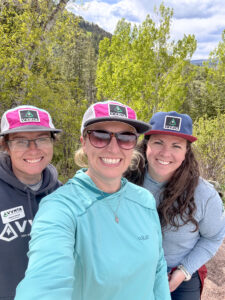
Trail Ambassador Responsibilities and Support
You Commit To
- Position yourself at trailheads, and/or hike/bike on the trail
- Sharing your passion for our trails and getting outside
- Positive and encouraging attitude communicating the joy and positive benefits that trails bring our community
- Educating trail users how to use them responsibly and sustainably
- Represent the VVMTA and partners in a professional and positive manner
- Volunteer 6 hours between April 16th – September 30th
- Submit a log capturing your engagement
- Be safe, have fun, and enjoy the experience
We Provide You With
- Trail ambassador materials (dog leashes, wag bags, LNT cards, etc.)
- Educational materials (brochures, pamphlets, etc.)
- VVMTA branded Patagonia hoody
- VVMTA hat of your choice from Ski Town All Stars
- Access to ExpertVoice & Outdoorly pro deals and Volunteer Rewards program
How It Works
Step 1: Plan Your Shift
- Pick a closed trailhead (spring) or summer trailhead listed below.
- Pick up Trail Ambassador materials from VVMTA’s office in Edwards.
- Register your shift, so we know where you’re headed.
Step 2: Complete Your Shift
- Head out on the trail, engage with users, and support sustainable recreation!
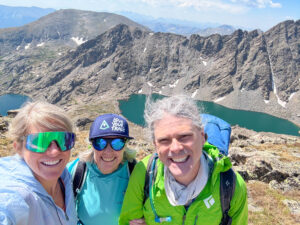
Step 3: Submit Your Log
- After your shift, complete your Trail Ambassador log within 24 hours to record your time and experiences.
- BONUS: If you’d like to report trail conditions / trail maintenance needs, please submit a log.
Trail Locations
Spring Trail Closures
Trail | Closures |
Brush Creek Valley Ranch & Open Space | Dec 1- June 30 |
Buffehr Creek (Vail) | April 15 -June 20 |
Everkrisp (Minturn) | Nov 23 – June 20 |
Everkrisp (EagleVail) | Nov 23 – June 20 |
Eagle River Preserve | December 1 – April 15 |
Eastern Hillside | Dec 1 – June 20 |
FS Road 779 (Wildridge) | Nov 23 – May 20 |
Green Gate | Oct 10 – June 20 |
Knob Hill | December 15 – April 15 |
Haymaker 3rd Loop | December 1 – April 15 |
Homestead L | December 1 – April 15 |
Mill Creek (Vail) | May 6 – June 30 |
North Trail (Vail) | April 15 – June 20 |
Paulie’s Plunge (Avon) | May 15 – June 20 |
Son of Middle Creek (Vail) | April 15 – June 20 |
Two Elk (Vail) | May 6 – June 30 |
Whiskey Creek (Minturn) | November 23 – June 20 |
Please visit vvmta.org/seasonsaltrailclosures for a complete list of trail closures and their opening date.
Summer (High-Use) Trails
Trail | Priority Level |
Beaver Lake | Top Priority |
Berry Creek | Medium Priority |
Bighorn | |
Booth Lake | |
Cataract Creek / CT Intersection at Camp Hale | |
Colorow Trail | Medium Priority |
Cougar Ridge | Medium Priority |
Cross Creek | Top Priority |
Deluge Lake | |
East Lake Creek | Medium Priority |
Fancy Pass | |
Fall Creek | |
Game Creek | |
Gore Creek | Top Priority |
Grouse Creek / Lake | Top Priority |
Lake Charles | Top Priority |
Lost Lake (Vail) | Top Priority |
Meadow Mountain | Top Priority |
Missouri Lakes | Top Priority |
Mt. of the Holy Cross | |
Nolan Lake | Top Priority |
North Trail | Medium Priority |
Pitkin Creek | |
Stag Gulch | Medium Priority |
Two Elk (West) | Medium Priority |
Tennessee Pass | Medium Priority |
Upper Piney River Trail | Top Priority |
Vail Pass | Top Priority |
West Grouse Creek | |
West Lake Creek | |
Yeoman / Brown’s Loop | Medium Priority |
Educating the Public
With increased access to the outdoors, more people than ever are recreating on public lands. The Vail Valley welcomes tens of thousands of visitors each year, leading to higher trail use throughout both winter and summer seasons. As we work to maintain and improve our trail network to meet this growing demand, Trail Ambassadors play a vital role in educating visitors about sustainable recreation, trail etiquette, and how to choose experiences that match their needs.
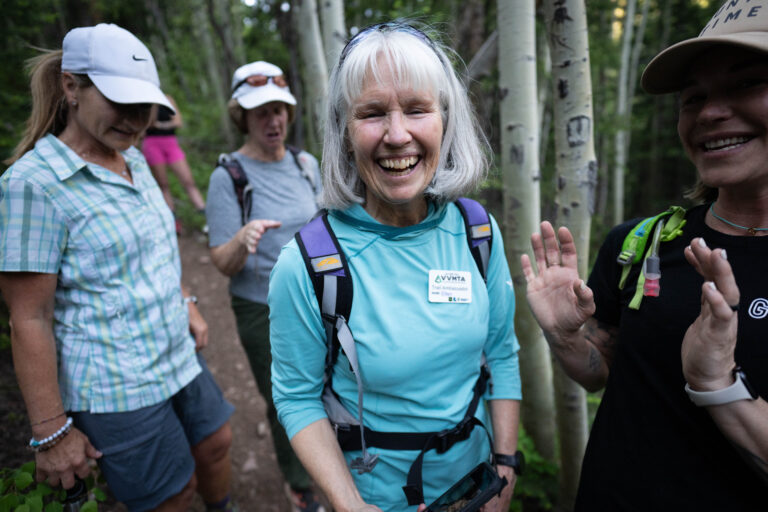
Do
- Keep in mind our #1 goal is to educate
- Be approachable—make eye contact and remove barriers (like sunglasses when possible)
- Meet visitors where they are; adjust your tone and language accordingly
- Lead into conversations naturally—don’t be abrupt
- Keep interactions positive and welcoming
- Be a good listener
- Be consistent and fair with all visitors
- Remember: we are educators, not enforcers
- Answer questions to the best of your ability—if you don’t know, say so and offer to find out
- Share the why behind trail etiquette and stewardship practices
- Lead by example in your behavior on the trail
- Give visitors the benefit of the doubt—many are new to these spaces
- Know when to disengage if a situation becomes unproductive
Do Not
- Get in a visitor’s personal space
- Be confrontational or escalate situations
- Display an overbearing or authoritative attitude
- Be critical, harsh, or dismissive
- Be abrupt, impatient, or rushed
- Act self-righteous or elitist
- Assume negative intent from visitors
- Use threatening or aggressive body language
- Lose your composure—never respond to frustration or anger with anger
- Provide incorrect information—avoid guessing or making things up
- Check weather and trail conditions before heading out
- Tell someone where you’re going and when you’ll be back
- Choose trails appropriate for your experience level
- Be aware of limited or no cell service in many areas
- Bring enough water and snacks
- Wear appropriate footwear and layers
- Carry sun protection (hat, sunscreen, sunglasses)
- Consider a small first aid kit
- Conditions can change quickly—always be prepared and willing to adjust plans
- Afternoon storms and high elevation can impact safety and energy levels
- Stay aware of your surroundings and trail conditions
- Respect wildlife: observe from a distance and never approach or feed animals
- You are not expected to enforce rules or intervene in unsafe situations
- Prioritize your own safety over assisting others
- If a situation feels unsafe, disengage
- Use good judgment when interacting with visitors
- Stay calm and assess the situation
- Call 911 if needed
- Provide clear location details (trail name, landmarks, GPS if possible)
- Share what happened and the condition of the person involved
- Contact Natalie
What To Bring
- Hiking pack
- VVMTA uniform – at least two logos and nametag
- Weather-appropriate clothing (think moisture-wicking and layers)
- Closed-toe shoes
- Sunscreen/hat/sunglasses
- Small notebook/pen/pencil
- Plenty of food and water
- Small first aid kit
- Garmin
- Other things to think about…
- Extra Socks
- Knife / multi-tool
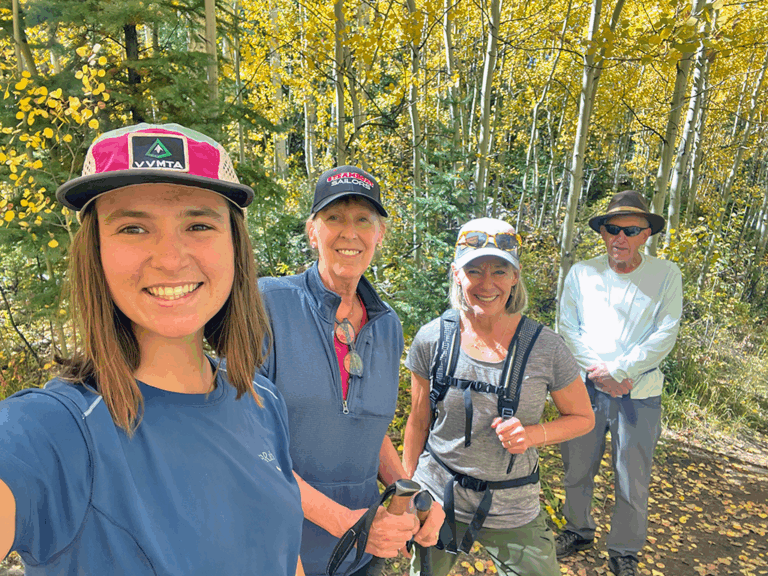
Education & Resources
Respect the Vail Valley
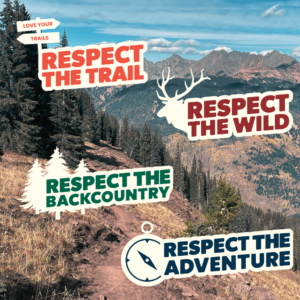
VVMTA, in partnership with Vail Valley Partnership and grant support from the Colorado Tourism Office, the Respect the Vail Valley campaign supports and utilizes familiar principles of outdoor recreation and ethics. The following is a breakdown of each way we can respect the Vail Valley.
- Respect the Adventure
Plan ahead, check conditions, and come prepared for changing weather and elevation. - Respect the Wild
Observe wildlife from a distance and avoid disrupting natural habitats. - Respect the Trail
Stay on designated trails, follow yield rules, and practice good trail etiquette. - Respect the Backcountry
Pack out what you pack in and recreate responsibly in remote areas.
Leave No Trace
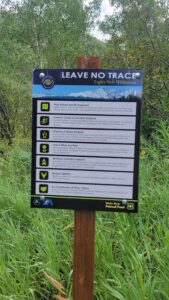
Leave No Trace provides simple guidelines to help protect the outdoors and minimize impact:
→https://lnt.org/why/7-principles/
- Plan Ahead & Prepare
Know the area, check conditions, and come prepared. - Stay on Durable Surfaces
Stick to established trails to protect vegetation and prevent erosion. - Dispose of Waste Properly
Pack out all trash, food waste, and pet waste. - Leave What You Find
Preserve natural and cultural features—don’t take or disturb them. - Minimize Campfire Impact
Follow fire restrictions and use established fire rings when allowed. - Respect Wildlife
Observe from a distance and never feed animals. - Be Considerate of Others
Share the trail and respect different ways people enjoy the outdoors.
Understanding Wilderness
Some of our trails in Eagle County fall under the definition of Wilderness.
The legal definition of Wilderness stemmed from concern of the growing population of the United States post-World War 2. The “baby boom” during the 1950s and 60s as well as the increase in transportation systems emphasized a need for environmental protection and conservation. As America’s highway system grew, the concern for air and water quality led to the first format of the Clean Air Act (enacted in 1963). Public land designation had been introduced prior to the 60s with the creation of the National Parks System in 1916, National Forests, and primitive areas.
Under President John F. Kennedy, he and his administration advocated for the passing of the Wilderness Act. After Kennedy’s assassination in 1963, Lyndon B. Johnson would resume advocacy for an environmental act that would serve as the basis for the protection and conservation of American lands. The 88th Congress of the United States passed The Wilderness Act on September 3rd, 1964.
Please note that the Wilderness Act of 1964 and previous legislation for environmental protection do not represent indigenous populations in the United States who had previously inhabited these spaces. Marginalized groups in the outdoors have not, historically, been represented by members of their communities nor have congressional acts recognized native peoples influence and connection to Federally protected lands. There is improvement in said recognition but please be mindful of the language used below.
An Act: To establish a National Wilderness Preservation System for the permanent good of the whole people, and for other purposes.
Definition of Wilderness: A wilderness, in contrast with those areas where man and his works dominate the landscape, is hereby recognized as an area where the earth and its community of life are untrammeled by man, where man himself is a visitor who does not remain. An area of wilderness is further defined to mean in this Act an area of underdeveloped Federal land retaining its primeval character and influence, without permanent improvements or human habitation, which protected and managed so as to preserve its natural conditions and which (1) generally appears to have been affected primarily by the forces of nature, with the imprint of man’s work substantially unnoticeable; (2) has outstanding opportunities for solitude or a primitive and unconfined type of recreation; (3) has at least five thousand acres of land or is of sufficient size as to make practicable its preservation and use in an unimpaired condition; and (4) may also contain ecological, geological, or other features of scientific, educational, scenic, or historical value.
How are wilderness different from other areas?
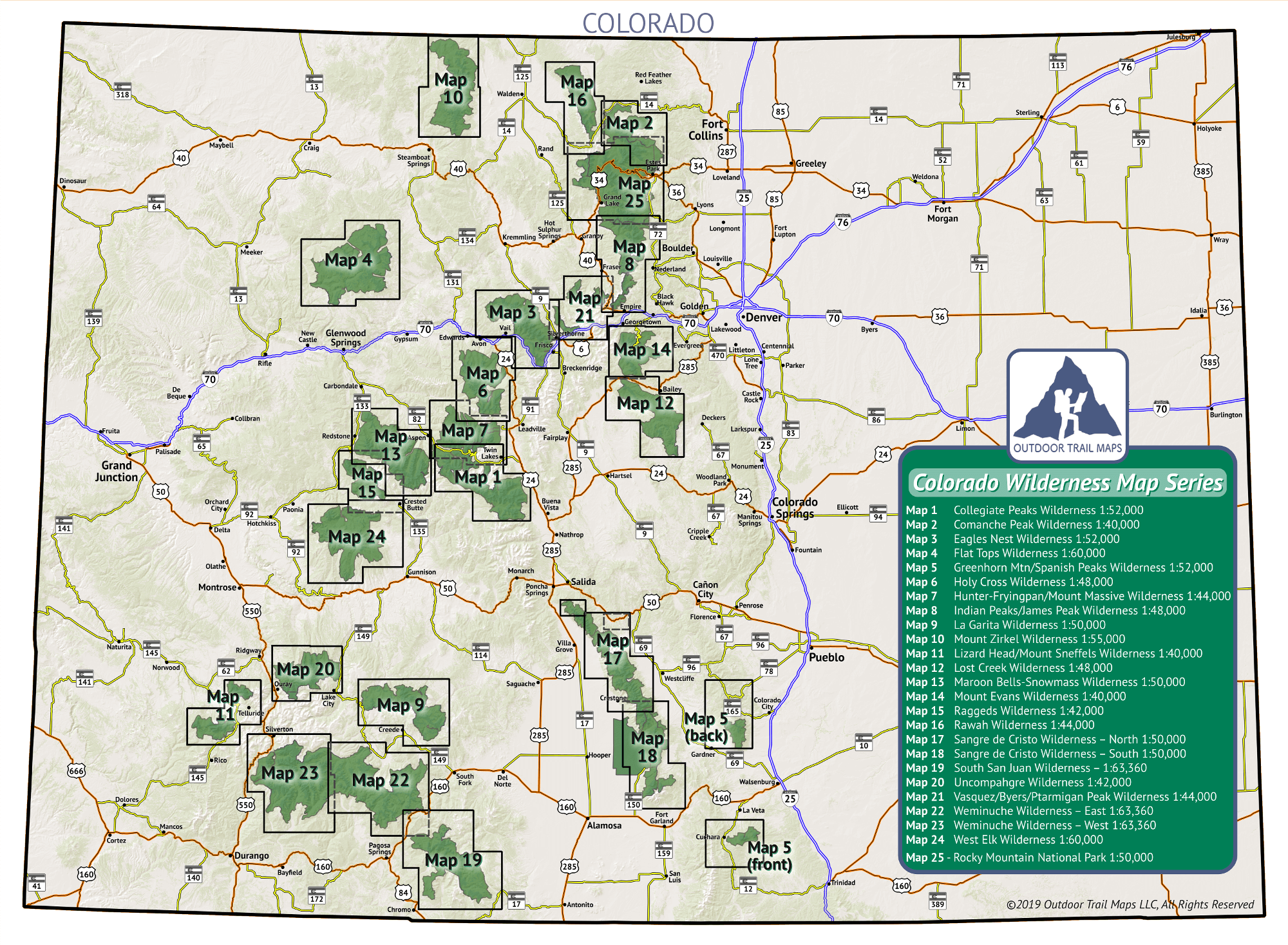
There are over 800 wilderness areas throughout 44 states and Puerto Rico, covering almost 112 million acres. In Colorado alone, there are over 3.7 million acres of wilderness. The Forest Service, Bureau of Land Management, Fish and Wildlife Service, and National Park Service all oversee and maintain these protected areas. The Holy Cross and Eagles Nest Wilderness both overlap Eagle County.
In designated wilderness areas, the use of motorized equipment is prohibited. This also includes “mechanical transport.” Bikes are considered a form of mechanical transport thus prohibited in wilderness areas. These jurisdictions are included in the Wilderness Act.
While there is some debate about the use of chainsaws in wilderness areas, administrative use of chainsaws has been permitted only when there are navigational hazards. Cross-cut saws are typically used by sawyers when applicable.
Please do not bring chainsaws-regardless if there is a spark arrestor or is electric-to wilderness areas. With our resources in multiple land agencies throughout the county, areas that require additional attention will be communicated to the FS, BLM, FWS, or NPS.
Has outstanding opportunities for solitude…
As written in the Wilderness Act, solitude is listed under the comprehensive definition of wilderness. Our reasons for recreation may vary but respecting the tranquility of these spaces connects with LNT Principle 7-Be considerate of others. We ask that you are mindful of this shared space and respecting others’ access to wilderness.
Eagle’s Nest Wilderness Rules and Regulations